Exclusive

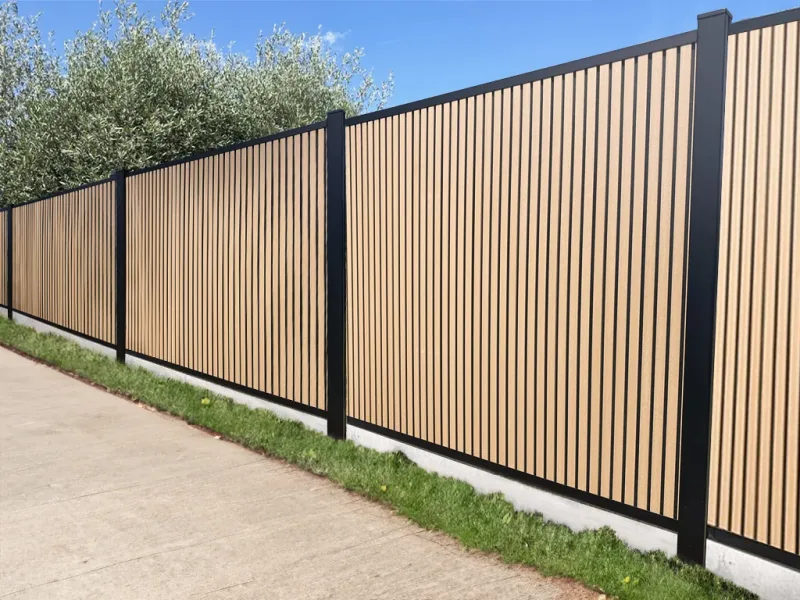
Bardline Composite Fence with Open-Slat Effect
- Open-slat effect
- Vertical composite slats, symmetrical appearance on both faces
- Length 1295 mm or 1600 mm on order depending on colour
Photo 1 of 2
Published files and resources to request when preparing a quote, specification or installation.
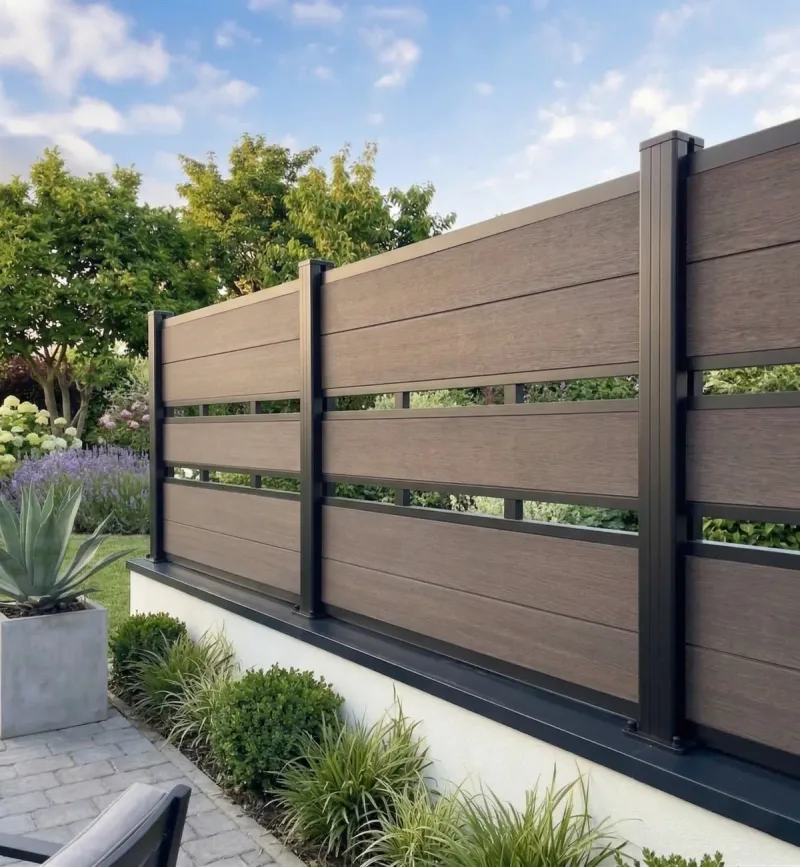
Claustral is a solid composite fence system with horizontal slats, designed to create an outdoor partition with a wood look and no visible gaps. Its co-extruded composite slats with a brushed finish are paired with aluminium posts and profiles dedicated to the system.
The Claustral slat measures 1795 x 166 x 20 mm, with a useful height of 158 mm. Declared expansion is 2 mm/m.
The Claustral composition includes the slats, posts and aluminium profiles dedicated to the system. Depending on the layout and the installation method, it can include an aluminium reinforcing slat profile, connection and finishing profiles, as well as the required fixing and support elements.
Claustral is offered in 1000, 1200, 1350, 1550, 1730, 1840 and 2000 mm. Configurations of 1000, 1200 and 1350 mm are specified for plate-mounted installation; those from 1550 to 2000 mm are intended for cast-in (in-ground) installation with the corresponding posts. The composition must be verified according to the height, substrate and layout of the project before installation.
The range is available in Anthracite grey EC 102, Wenge EC 017 and Light oak EC 401.
Claustral is aimed in particular at resellers and installers who assemble fences for their projects. Technical documents and the installation manual allow verification of the necessary components before site preparation.
Claustral forms a solid fence with horizontal slats. Bardline uses vertical slats and creates a louvered effect with daylight gaps. The choice therefore depends on the desired appearance and the project configuration.
The product sheet specifies maintenance with a pressure washer at a minimum distance of 1 metre. Claustral benefits from a stated 10-year warranty.
Claustral slat: 1795 x 166 x 20 mm, useful height 158 mm. Declared expansion: 2 mm/m. Aluminium posts and profiles are part of the Claustral system.
Find the products and useful documents to prepare your Claustral configuration.
Provide the Claustral reinforcing profile according to the layout and the project height. Plate-mounted and cast-in configurations do not use the same elements: consult the installation manual and have the composition validated before installation.